• Gen. Yakubu Gowon Says Two Christian Friends in Plateau Betrayed Him in New Memoir

Former Nigerian Head of State, General Yakubu Gowon (Rtd.), has revealed that two of his Christian friends from Plateau State betrayed him, saying the experience remains one of the painful memories of his life.

Gowon made the revelation in his newly launched memoir, My Life of Duty, unveiled in Abuja during a ceremony attended by prominent national figures, including Vice President Kashim Shettima, Emir of Kano Muhammadu Sanusi II, former President Goodluck Ebele Jonathan, former First Lady Aisha Buhari, former Heads of State, senior military officers, diplomats, and other distinguished guests.

In the book, the former Head of State recalled that two of his Christian friends in Plateau State abandoned and betrayed him, noting that the incident left a lasting emotional impact.

According to Gowon, despite the passage of time, he still feels the pain of what he described as their betrayal.

The elder statesman explained that one of the major reasons for writing My Life of Duty was to correct what he described as longstanding misconceptions and inaccurate interpretations about his life, his leadership, and the policies of his administration.

He said the memoir offers his personal account of key events in Nigeria
  • Trump said the United States was protecting allied Gulf countries and that these nations should reimburse the US for its security role
  • Trump said the United States was protecting allied Gulf countries and that these nations should reimburse the US for its security role
  • Firefighters worked to contain a blaze that spread into the Fontainebleau forest, prompting a full closure of the A6 motorway south of Paris.
  • Three Years After Lalong Left Office, Nigerians Reflect on His Legacy

Three years after the administration of former Plateau State Governor Simon Bako Lalong came to an end, residents and political observers have continued to reflect on his eight-year tenure, with discussions centering on his achievements, shortcomings, and overall legacy.

Across social media platforms and public forums, many Nigerians have been asking a common question: "Three years after the Lalong administration ended, what stands out most to you about his time in office?"

The question has generated diverse reactions, with some respondents highlighting infrastructure development, road construction, educational reforms, and efforts to promote peaceful coexistence during his administration.

Others, however, pointed to persistent security challenges, economic concerns, unemployment, and governance issues, arguing that these remain among the defining aspects of Lalong
  • Malaysia PM
  • Turkey Evaluates Participation in Canada
  • Nazari Da Bincike a Qarni na Ashirin da Daya 

Full video in the comment👇
  • About Morganable
    • Editorial Team
    • Ownership and Funding
  • Contact Us
  • Policy Hub
    • Editorial Standards | Morganable
    • Corrections Policy | Morganable
    • Terms of Use | Morganable
    • Advertising Policy | Morganable
    • Privacy Policy | Morganable
  • My Account
    • Sign Up
    • Log In
    • Reset Password
    • My Profile
  • Share Your Story
Wednesday, July 15, 2026
  • Login
  • Register
No Result
View All Result
MORGANABLE
  • Home
  • News
    • Security & Justice
    • Communities
    • Health
    • Education
    • World
  • Politics
    • Governance
    • Policy
    • Political Analysis
    • Elections
  • Africa
    • West Africa
    • East Africa
    • Southern Africa
    • North Africa
    • African Union
    • History & Civilisation
    • Africa Analysis
      • Africa’s Forgotten Human Rights Charter
  • Business
    • Markets
    • Industries
    • Currencies
    • Crypto & Digital Assets
    • Personal Finance
  • Technology
    • Fintech
    • Startups
    • Artificial Intelligence
    • Digital Economy
    • Telecoms
    • Cybersecurity
  • Agriculture
    • Food Security
    • Agribusiness
    • Farming
    • Supply Chains
    • Markets & Prices
    • Data Intelligence
  • Life & Culture
    • Fashion
    • Music
    • Film & TV
    • Arts & Culture
    • Books
    • Travel
    • Gaming
    • Health & Wellbeing
    • Food & Drink
    • Personal Development
  • Analysis
    • Explainers
    • Special Reports
    • Investigations
    • Briefings
    • Data Intelligence
  • Video
    • Interviews
    • Video Explainers
    • Video Briefings
    • Documentaries
  • Opinion
    • Executive Editor’s Desk
    • Op-Eds
    • Editorials
    • Columns
    • Letters
  • More
    • Sports
    • Features
    • Entrepreneurship
    • Morganable Hausa
    • Policy Hub
    • Editorial Team
    • About Morganable
    • Corrections Policy
    • Advertise With Us
    • Share Your Story
    • Contact Us
  • Home
  • News
    • Security & Justice
    • Communities
    • Health
    • Education
    • World
  • Politics
    • Governance
    • Policy
    • Political Analysis
    • Elections
  • Africa
    • West Africa
    • East Africa
    • Southern Africa
    • North Africa
    • African Union
    • History & Civilisation
    • Africa Analysis
      • Africa’s Forgotten Human Rights Charter
  • Business
    • Markets
    • Industries
    • Currencies
    • Crypto & Digital Assets
    • Personal Finance
  • Technology
    • Fintech
    • Startups
    • Artificial Intelligence
    • Digital Economy
    • Telecoms
    • Cybersecurity
  • Agriculture
    • Food Security
    • Agribusiness
    • Farming
    • Supply Chains
    • Markets & Prices
    • Data Intelligence
  • Life & Culture
    • Fashion
    • Music
    • Film & TV
    • Arts & Culture
    • Books
    • Travel
    • Gaming
    • Health & Wellbeing
    • Food & Drink
    • Personal Development
  • Analysis
    • Explainers
    • Special Reports
    • Investigations
    • Briefings
    • Data Intelligence
  • Video
    • Interviews
    • Video Explainers
    • Video Briefings
    • Documentaries
  • Opinion
    • Executive Editor’s Desk
    • Op-Eds
    • Editorials
    • Columns
    • Letters
  • More
    • Sports
    • Features
    • Entrepreneurship
    • Morganable Hausa
    • Policy Hub
    • Editorial Team
    • About Morganable
    • Corrections Policy
    • Advertise With Us
    • Share Your Story
    • Contact Us
No Result
View All Result
MORGANABLE
No Result
View All Result
Home Features Profile Watch

Rolihlahla “Nelson” Mandela: Life Story Of A Patriot

Biography, Life And Story Of A True Icon

by Disu Adams
December 28, 2024
in Profile Watch
0 0
0
Rolihlahla “Nelson” Mandela: Life Story Of A Patriot

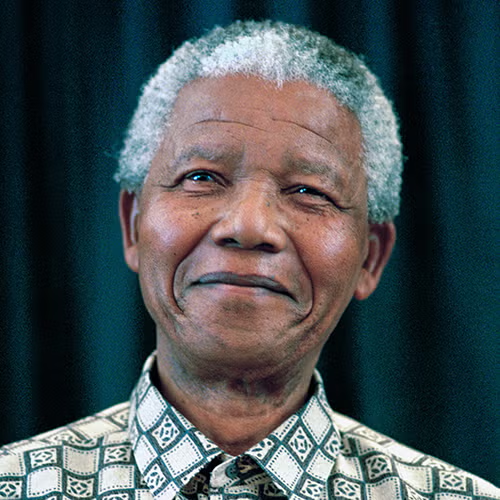
Former President of South Africa Nelson Mandela. Photo Credit: Biography

Article Lens
How to read this story
Desk
Profile Watch
Story Mode
Political Report
Region
Africa
Public Interest
Public power, representation and democratic consequence
In This Story Navigate the argument, evidence and consequence
Early Years/Childhood Education Political Career The Treason Trial Travel On A Falsified Ethiopian Passport Freedom From Imprisonment Presidency

Rolihlahla “Nelson” Mandela: life story of a patriot. Biography, life and story of a true Icon

On 18th July 1918, Nelson Rolihlahla Mandela was born into the Madiba clan in Mvezo village, Eastern Cape, South Africa.

His mother’s name was Nonqaphi Nosekeni while his father’s was Nkosi Mphakanyiswa Gadla Mandela who happened to be the principal counsellor to the Interim king of the people of Thembu, Jongintaba Dalindyebo.

Early Years/Childhood

At the age of twelve (12), in 1930, Rolihlahla’s father died and at the very young age, he became a ward of Jongintaba at the Great Place in Mqhekezweni.

While being educated with the stories of his ancestors during the wars of resistance, he became very fascinated by the idea of contributing his own quota to the struggle for freedom of his people.

Education

Rolihlahla started his primary school and had the opportunity to meet with Miss Mdingane, a mentor teacher, who named him “Nelson,” regarding a mandatory requirement of giving every schoolchild a “Christian” name.

After he graduated from the elementary school, he completed his Junior Secondary School at Clarkebury Boarding Institute and furthered to Healdtown, a Wesleyan secondary school, where he has his matriculation.

Rolihlahla “Nelson” Mandela: Life Story Of A Patriot
Nelson Mandela During His Primary School Days. Photo Credit: Sutori

Mandela gained admission to University College of Fort Hare to study a Bachelor of Arts, but was unable to complete his first degree programme following his involvement in a student protest which rocked the entire school.

Rolihlahla “Nelson” Mandela: Life Story Of A Patriot

Upon his return to the Great Place at Mqhekezweni, the King became infuriated and said if he (Mandela) refused to return to Fort Hare, he would for him and his cousin Justice into early marriages.

In 1941, while avoiding the king’s wrath, Mandela and his cousin, Justice, fled to Johannesburg. He started working as a mind security guard where he met with an estate agent Walter Sisulu who eventually introduced him to Lazer Sidelski.

He then did his articles through a firm of attorneys –Witkin, Eidelman and Sidelsky.

After completing his BA at the University of South Africa, he returned to Fort Hare in 1943 for his graduation.

Meanwhile, he started to study for an LLB at the University of the Witwatersrand and by his own conviction, he called himself a poor student and quit his studies in 1952 without graduating.

He returned to school in 1962 through the University of London after his jail term, but quite unfortunate again, he did complete the degree.

So, 1989, while in the last month of his imprisonment, he obtained an LLB from the University of South Africa. He graduated while in absentia at a ceremony in Cape Town.

Political Career

Mandela moved to Johannesburg in 1941. This move opened his eyes not only to an industrial city but also to a nation of injustice based on racial segregation.

For the first time, he saw himself as a black man in a white society.

He began working as a law clerk with Walter Sisulu, a prominent black businessman active in the African National Congress (ANC).

While proactively involved in politics since 1942, Mandela joined the African National Congress (ANC) in 1944 where he was instrumental to the formation of the African National Congress Youth League (ANCYL).

In 1944, he married Evelyn Mase, a nurse, and Walter Sisulu’s cousin.

There marital union was blessed with four (4) children− two (2) sons and two (2) daughters−Madiba Thembekile “Thembi,” Makgatho but the two daughters were both called Makaziwe, with the first of the girls died in infancy.

Mandela and Evelyn Mase, his wife, divorced in 1958.

Rolihlahla “Nelson” Mandela: Life Story Of A Patriot

Mandela’s ascension started in ANCYL and through his immense contribution and efforts, the ANC adopted a more radical mass-based policy, named the Programme of Action, in 1949.

In 1952, he was named the National Volunteer-in-Chief of the Defense Campaign alongside Maulvi Cachalia as his deputy. This campaign of civil resistance was against six (6) illegal laws.

The movement was programmed between the ANC and the South African Indian Congress.

He with 19 others was charged under the Suppression of Communism Act for their involvement in the campaign and convicted to nine-month imprisonment with hard labor and banned for two years.

Despite his Bachelor of Arts degree, Mandela also had a two-year diploma in law which qualified him to practice law.

In August 1951, Mandela and Oliver Tambo established South Africa’s first black-owned law firm named, Mandela & Tambo.

Although, there were at least 2 other black owned law firms before Mandela and Tambo

Towards the end of 1952, Mandela was banned for the first time. As a matter of restriction placed on him, he could only be allowed to watch, in secret, as the Freedom Charter was introduced in Kliptown on 26th June, 1955.

The Treason Trial

Rolihlahla “Nelson” Mandela: Life Story Of A Patriot
Nelson Mandela With Others Convicted For Treason. Photo Credit: Afropean

On 5th December, 1956, Mandela was apprehended during a nationwide police swoop which occasioned his 1956 Treason Trial.

Men and women of all walks of life and races found themselves behind bars in the lengthy trial which could only end when the last twenty-eight (28) accused, including Mandela, were set free on 29th march, 1961.

On 21st March 1960, the South African police killed 69 unarmed civilian in a confrontation in Sharpeville against the pass laws which catalyzed the country’s first state of emergency and the suspension of ANC and the Pan Africanist Congress (PAC) on 8th April of the same year.

Mandela and his companions were among thousands of others remanded during the state of emergency.

On 14th June, 1958, during his trial, he married Winnie Madikizela, a social worker. They went on to have two (2) daughters, Zenani and Zinziswa. They got divorced in 1996−after thirty-eight years of marriage, 1996.

A few days before the end of the Treason Trial, Mandela travelled long to Pietermaritzburg to speak at the All-in Africa Conference where he wrote to Prime Minister Verwoerd, demanding a national conference devoid of racial constitution and he threatened that if declined, a nationwide strike would be embarked upon against South Africa becoming a republic.

Rolihlahla “Nelson” Mandela: Life Story Of A Patriot

After he was acquitted, along with his colleagues, of Treason, Mandela disappeared from the public view, secretly planning a three-day nationwide strike, 29th, 30th and 31st March.

In the wake of massive deployment and reinforcement of state security forces, the strike was called off early.

And in June 1961, he was implored to marshal the armed struggle and aided the establishment of Umkhonto weSizwe (Spear of the Nation), which was launched on 16th December, 1961, with various numbers of explosions.

Travel On A Falsified Ethiopian Passport

On eleventh (11th) January, 1962, with an adopted name, David Motsamayi, Mandela absconded South Africa.

He travelled to various African countries and visited England where he canvassed support for the armed struggle.

Mandela was militarily trained in Morocco and Ethiopia before returning to South Africa in July, 1962.

He was nabbed in a police roadblock around Howick on fifth (5th) August when he was returning from KwaZulu-Natal, where he went to brief ANC President Chief Albert Luthuli about his absence.

Subsequently, he was charged with illegal absenteeism and involvement in inciting nationwide strike against the government.

He got jailed for five (5) years which he served at the Pretoria Local Prison.

On 27th May, 1963, he was transferred to Robben Island and brought back to Pretoria on 12th June.

Within the pace of a month, the police ransacked Liliesleaf, an unpopular hideout in Rivonia, Johannesburg, used by ANC and the Communist Party activists which led to the arrest and apprehension of various comrades.

Mandela joined ten (10) others on trial for wanton destruction in what was widely known as the Rivonia Trial. Which facing the reality of death sentence, his famous words to the court, “Speech from the Dock” on 20th April, 1964 became immortalized:

Rolihlahla “Nelson” Mandela: Life Story Of A Patriot

“I have fought against white domination, and I have fought against black domination.

I have cherished the ideal of a democratic and free society in which all persons live together in harmony and with equal opportunities.

“It is an ideal which I hope to live for and to achieve. But if needs be, it is an ideal for which I am prepared to die.”

Mandela’s Speech From The “Dock Quote, 20th April, 1964.

On 11th June, 1964, Mandela with seven other accused persons−Walter Sisulu, Ahmed Kathrada, Govan Mbeki, Raymond Mhlaba, Denis Goldberg, Elias Motsoaledi and Andrew Mlangeni, was convicted and sentenced to life imprisonment on the next day.

Due to Goldberg being white, he was sent to Pretoria Prison while Mandela and others convicted persons were sent to Robben Island.

Mandela lost his mother in 1968 and his eldest son, Thembi, in 1969 respectively but he was not permitted to be present at both funerals due to the conditions surrounding his conviction.

Mandela was transferred to Pollsmoor Prison in Cape Town with Sisulu, Mhlaba and Mlangeni on 31st March, 1982, Kathrada joined them in October.

In November, 1985, following his successful prostrate surgery, Mandela was held alone. The-then Minister of Justice Kobie Coetsee visited him in the hospital.

Later, Mandela engineered a dialogue between the apartheid government and the ANC.

Freedom From Imprisonment

On 12th August, 1988, Mandela was taken to hospital where he was diagnosed with tuberculosis.

On seventh (7th) December, 1988, after he had spent more than three months in two hospitals, he was transferred to a house at Victor Verster Prison close to Paarl where he was made to spend last 14 months in prison.

Rolihlahla “Nelson” Mandela: Life Story Of A Patriot

Mandela was released on Sunday, 11th February, 1990, nine (9) days after lifting of bans placed on the ANC and the PAC, and almost four (4) months after the release of his remaining Rivonia comrades

It was learned that while serving his jail term, Mandela had rescinded three conditional offers of release.

He actively engaged himself in official dialogue to end white minority rule and in 1991, he was elected ANC president in place of his sick friend, Oliver Tambo.

In 1993, he and President FW de Klerk jointly won the Nobel Peace Prize and on 27th April, 1994, Mandela participated in voting exercise for the first time.

Presidency

On May 10, 1994, at age 77, Mandela was inaugurated as South Africa’s first black President at the Union Building in Pretoria.

The ceremony was televised internationally and numerous people gathered to witness the inauguration speech.

Rolihlahla “Nelson” Mandela: Life Story Of A Patriot
Nelson Mandela During His Presidency. Photo Credit: Morganable

During his presidency, Mandela worked tirelessly rebuilding South Africa’s economy which was in crisis from the apartheid, as well as poverty, inequalities, unequal access to social services, and infrastructure.

On his eightieth (80th) birthday in 1998, he took Graca Machel as his third wife.

After a term in office, Mandela gave a live broadcast and quit his role in February 1999 as the President of South Africa.

He proceeded his work with the Nelson Mandela Children’s Fund−an organization which he established in 1995 under the Nelson Mandela foundation and The Mandela Rhodes Foundation.

His grandson, Mandla Mandela, in April 2007, was named the head of the Mvezo Traditional Council at an event at the Mvezo Great Place.

Through-out his life, Mandela never compromised his commitment and passion for democracy, equality and learning.

Amidst horrific provocation and hindrances, he never condoned racism or answered racism with racism.

He entire life serves as a motivation and an inspiration to the oppressed, suppressed and the deprived; and to all who want to resist oppression, suppression and deprivation.

On fifth (5th) December, 2013, Mandela died in his home in Johannesburg.

Rolihlahla “Nelson” Mandela: Life Story Of A Patriot. 

Share this:

  • Share on Facebook (Opens in new window) Facebook
  • Share on X (Opens in new window) X
  • Share on LinkedIn (Opens in new window) LinkedIn
  • Share on Pinterest (Opens in new window) Pinterest
  • Share on WhatsApp (Opens in new window) WhatsApp
  • Email a link to a friend (Opens in new window) Email
  • More
  • Share on Reddit (Opens in new window) Reddit
  • Print (Opens in new window) Print
  • Share on Tumblr (Opens in new window) Tumblr
  • Share on Telegram (Opens in new window) Telegram
Morganable Briefing Stay with the story beyond the headline.

Get Morganable’s independent reporting, analysis and data-backed insight on Nigeria, Africa and the wider world.

Join the Briefing
Editorial Trust How Morganable protects public-interest journalism.

Our reporting is guided by accuracy, independence, fairness, transparency, correction discipline and public-interest relevance.

Editorial Standards Corrections Ownership & Funding
Morganable articles are produced for readers who want reporting with context, analysis with discipline and journalism that treats public consequence seriously.

Like this:

Like Loading…

Related

Tags: AfricaAfrican National Congress (ANC)African National Vongress Youyh LeagueAparthied GovernmentCape TownEnglandEthipiaJohannesburgNelson MandelaThe Great PlaceUniversity Of South Africa
Disu Adams

Disu Adams

A Renowned Media Personality And Gifted Media Expert Known For Exceptional Quality To Source And Produce Captivating Contents

Recommended

Regina Daniels and Shaffy Bello Stir Marriage Debate

Regina Daniels and Shaffy on Marriage Debate

1 month ago
Funke Akindele's 'BTS' Hits ₦2.4 Billion

Funke Akindele’s ‘BTS’ Hits ₦2.4 Billion

2 weeks ago

Popular News

  • Burna Boy Marks His 35th Birthday

    Burna Boy Marks His 35th Birthday

    0 shares
    Share 0 Tweet 0
  • Oyo Abduction:Senate Faults Makinde’s Call For UN Probe

    0 shares
    Share 0 Tweet 0
  • Toke Makinwa Sparks Gender War on Podcast

    0 shares
    Share 0 Tweet 0
  • FG Inaugurates Advisory Committee To Review Economic Reforms

    0 shares
    Share 0 Tweet 0
  • Dangote Refinery Begins Petrol Sales In Dollars

    0 shares
    Share 0 Tweet 0

Follow me

Morganable News Logo

Morganable News Logo

Morganable News Logo

Morganable

Morganable Logo

Morganable

Independent Digital-First Newspaper

Morganable is an independent digital-first newspaper owned by Morganable Media Group, publishing journalism across news, business, entrepreneurship, spotlights, entertainment, sports, lifestyle and opinion for readers in Nigeria, Africa and the wider world.

Editorial Trust

  • Policy Hub
  • Editorial Standards
  • Publishing Principles
  • Ethics Policy
  • Corrections Policy
  • Actionable Feedback Policy

Transparency & Commercial

  • Ownership and Funding
  • Diversity Policy
  • Advertising Policy
  • Sponsored Content Policy
  • Diversity Staffing Report

Legal & Reader Rights

  • Terms of Use
  • Privacy Policy
  • Cookie Policy
  • Contact Us

© 2019–2026 Morganable. Owned by Morganable Media Group. Independent digital-first newspaper. All rights reserved.

Welcome Back!

Login to your account below

Forgotten Password? Sign Up

Create New Account!

Fill the forms bellow to register

All fields are required. Log In

Retrieve your password

Please enter your username or email address to reset your password.

Log In

Add New Playlist

Facebook
No Result
View All Result
  • Home
  • News
    • Security & Justice
    • Communities
    • Health
    • Education
    • World
  • Politics
    • Governance
    • Policy
    • Political Analysis
    • Elections
  • Africa
    • West Africa
    • East Africa
    • Southern Africa
    • North Africa
    • African Union
    • History & Civilisation
    • Africa Analysis
      • Africa’s Forgotten Human Rights Charter
  • Business
    • Markets
    • Industries
    • Currencies
    • Crypto & Digital Assets
    • Personal Finance
  • Technology
    • Fintech
    • Startups
    • Artificial Intelligence
    • Digital Economy
    • Telecoms
    • Cybersecurity
  • Agriculture
    • Food Security
    • Agribusiness
    • Farming
    • Supply Chains
    • Markets & Prices
    • Data Intelligence
  • Life & Culture
    • Fashion
    • Music
    • Film & TV
    • Arts & Culture
    • Books
    • Travel
    • Gaming
    • Health & Wellbeing
    • Food & Drink
    • Personal Development
  • Analysis
    • Explainers
    • Special Reports
    • Investigations
    • Briefings
    • Data Intelligence
  • Video
    • Interviews
    • Video Explainers
    • Video Briefings
    • Documentaries
  • Opinion
    • Executive Editor’s Desk
    • Op-Eds
    • Editorials
    • Columns
    • Letters
  • More
    • Sports
    • Features
    • Entrepreneurship
    • Morganable Hausa
    • Policy Hub
    • Editorial Team
    • About Morganable
    • Corrections Policy
    • Advertise With Us
    • Share Your Story
    • Contact Us
  • Login
  • Sign Up

© 2019–2026 Morganable. Owned by Morganable Media Group. Independent digital-first newspaper. All rights reserved.

Loading Comments...

    %d
      Verified by MonsterInsights